
The online summit was Sept 12-17, 2020 but you can still view all of the videos for $15.
To purchase the entire package of videos for $15 with unlimited access anytime CLICK HERE
Find information on post-Convergence meetings, offerings, and roles here: https://www.forestmarchbc.com/2020/10/02/post-convergence-meetings-offerings-roles/
This online summit will bring people together to build a new forest framework
that respects nature & Indigenous systems and gives power back to communities.
Scroll to the bottom to sign up for updates.
WHAT WE KNOW
- Industrial logging is destroying our last primary forests, wildlife habitat and water.
- Legislation gives private corporations authority over public land.
- Communities have no power.
THIS SUMMIT WILL HELP EDUCATE, ORGANIZE, AND LEAD
What are alternative forestry models?
How do we protect forests, habitat, and water?
How do we form a coalition community group, build a movement, and create effective political action?
GOALS OF THE SUMMIT
To unite and empower BC communities located on the front lines of forestry by creating a network of engaged resistance plus solidarity for nature-based management of BC forests.
To establish a movement of lobbyists for BC legislative reform which represents community views, promotes nature-based forestry, and ensures more local forestry jobs.
To tell the BC government to change forestry legislation to ensure:
- Ecosystem health is a top priority (including protecting old growth).
- Formal involvement of front line communities in the management of public land.
- Prohibition of private corporations from having any level of authority over public land.
FREE PRESENTATIONS, INTERVIEWS, PANELS
Speakers include Indigenous and non-indigenous scientists, activists, eco-foresters, educators, elders, and youth.
Registration is free. Donations help cover costs. They can be made using Paypal below or via etransfer to forestmarchbc (at) gmail (dot)com.
Every presentation will be aired for free for 48 hours. After that, a package of all of the presentations is available for purchase for $15. Once you buy the package it is available for you to view anytime for an unlimited time.
This is a grassroots organized event and is not associated with a specific organization. The organizing team includes Jennifer Houghton, Taryn Skalbania, and Michelle Connolly. Many others have helped with ideas and contributions, including Daniel Pierce of Heartwood Documentree.
More info coming soon! Including speakers bios and more details about the sessions.
CHECK OUT OUR FANTASTIC GUESTS!
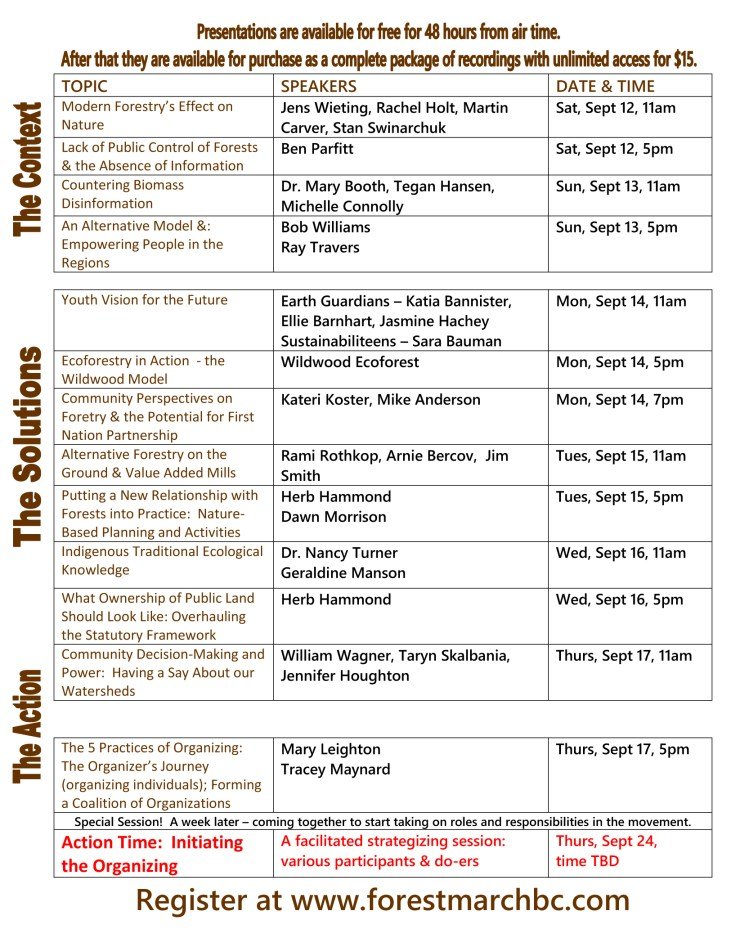
Downloadable schedule and description: https://www.forestmarchbc.com/wp-content/uploads/2020/09/BC-FOREST-PEOPLES-CONVERGENCE-SCH-DESCPTN-18.pdf
To purchase the entire package of videos for $15 with unlimited access anytime CLICK HERE
DONATIONS TO HELP THE ORGANIZING CONTINUE
Many of you are like me and have put in hundreds of hours of volunteer time to save our forests. I do this because every little mushroom, every tiny bird, every fuzzy bear, and every giant cedar is a life that matters to me. These donations cover my time and organizing costs (travel, time spent on computer trying to ignore my dogs jumping around asking for forest walks, website, etc). Whatever your reasons for donating, I’m grateful! ~ Jennifer Houghton *Please note, donations are not for the video package - to purchase the video package please see below. If you already made a donation thinking it was for the package, please email me - I’ll have to send you the link manually: forestmarchbc (at) gmail.com
Donations can also be made via e-transfer to forestmarchbc (at) gmail (dot) com
To purchase the entire package of videos for $15 with unlimited access anytime CLICK HERE
SIGN UP FOR UPDATES & ACTIONS
CLIP FROM ONE OF THE SUMMIT SESSIONS:
The summit takes a holistic approach to forestry reform - covering topics from legislative and governance options to value-added sawmills to nature-based solutions for the forestry crisis. In this sample clip, Geraldine Manson, First Nations Elder and Dr. Nancy Turner discuss the value of and examples from traditional ecological knowledge in BC. Full presentations start Sept 10. Register above.
RESOURCES
Restoring Forestry in BC. The story of industry’s decline and the case for regional management. By Bob Williams.
GUEST BIOS (being added daily)
Taryn Skalbania, Summit + March Co-organizer
Taryn grew up in East and West Vancouver BC and now calls Peachland home, where she and husband Rob now manage their hobby farm.
She volunteers for various community groups including: the Peachland Residents’ Association, the Mayor’s Compost Committee, the BC Coalition for Forestry Reform’ and the Peachland Watershed Protection Alliance.
When Taryn came to the Okanagan she was shocked and appalled at the industrial and multi-use of theback country, especially the unrestricted use of a community watershed. It is this unbalance that has driven Taryn to co-found the Peachland Watershed Protection Alliance. They work toward educating and informing Peachland residents on the threats and pressures on our watershed.
Taryn is one of the co-organisers of our online convergence and the BC-wide forest march happening on Sept 18 2020.
Martin Carver, Guest for: Modern Forestry’s Effect on Nature
Martin Carver is a hydrologist and fluvial geomorphologist with 25 years’ experience in water resources, emphasising land-use, conservation and risk assessment. His work focuses on forestry and various other sectors in the Columbia, Peace, Athabasca and Liard River systems. He is co-author of the 2019 Watershed Assessment Guideline jointly published by Engineers and Geoscientists BC and the Association of BC Forest Professionals. He is co-author of the water-quality procedure applied across the province under the Forest and Range Evaluation Program. He authored a 2017 report for the Columbia Basin Trust assembling the state of water science and water monitoring in the Columbia Basin in relation to climate change. He works across western Canada as an independent consultant, based in Nelson.
Dr. Rachel Holt, Guest for: Modern Forestry’s Effect on Nature
Dr. Rachel Holt is a professional biologist who has worked as an independent consultant based in Nelson for the last 20 years.
She works on a variety of issues which have often revolved around how to better manage the public forest to maintain ecological, societal, and cultural values, with clients including the Province of BC, forest companies, First Nations and environmental groups. She has been co-chair of the Forest Practices Board.
Rachel recently wrote a report with co-authors Karen Price and Dave Daust entitled: BC’s Old Growth Forest: A Last Stand for Biodiversity. The full report is available on her website at : https://veridianecological.ca/publications/#OAFA
Karen, Rachel and Dave wrote this report under their own steam after each working in old forest management issues in BC for more than 20 years. They saw a longstanding gap in publicly-available analysis and were moved to start to fill that gap, particularly in order to help inform the provincial Old Growth Panel.
Jens Wieting, Guest for: Modern Forestry’s Effect on Nature
As Senior Forest and Climate Campaigner for Sierra Club of BC, Jens works on protecting BC’s spectacular rainforest and fighting global warming. His primary focus are solutions to maintain the ecological integrity and the climate-stabilizing role of BC’s globally rare temperate rainforests, from Vancouver Island to the Great Bear Rainforest. Jens is following climate science and advocates for strong climate action to phase out fossil fuels and speed up the transition to zero emissions.
Jens grew up in West Germany and spent time in the Amazon rainforest between high school and university, he got hooked on rainforests and concerned about their fate.
Prior to coming to Canada, Jens worked as Tropical Forest Campaigner for German environmental organization Robin Wood, helping protect the rainforest of Indonesia. He also worked for a German development cooperation in Nicaragua to help conservation planning in Biosphere Reserve Bosawas, the largest tropical rainforest region of Central America. Jens has written numerous articles for Canadian and German newspapers about environmental issues.
Stan Swinarchuk, Guest for: Modern Forestry’s Effect on Nature
Stan grew up in the Kootenay-Boundary area of southern BC where he was introduced to forestry in the 1960s at the tender age of 14. He raised a family in the region and has spent much of his life fishing, hunting, and doing selective logging in the Kettle and Granby watersheds. Currently he is on the Board of the Boundary Forest Watershed Stewardship Society and puts in hundreds of hours acting as a forest watchdog. As a citizen scientist he has a deep understanding of the watershed ecology, hydrology, biodiversity, and soils.
Ben Parfitt, Guest for Lack of Public Control of Forests & Absence of Information
Ben Parfitt is a long-time researcher and writer, specializing in natural resource management issues. He has written numerous award-winning investigative feature articles for magazines, and is the author of two books on forest and land-use issues—Forestopia: A Pracitical Guide to the New Forest Economy (co-authored with Michael M’Gonigle) and Forest Follies: Adventures and Misadventures in the Great Canadian Forest. He has authored numerous peer-reviewed reports on forest management and water and energy issues in his capacity as a resource policy analyst with the B.C. office of the Canadian Centre for Policy Alternatives (CCPA). He devoted considerable time to the water-energy nexus as part of a joint research initiative between the CCPA and the POLIS Project on Ecological Governance. He is frequently called on to provide commentary to media outlets, briefings to government agencies, and lectures and public talks on environmental and resource management topics.
Ray Travers, Guest for An Alternative Model & Empowering People in the Regions
Ray is from McBride, British Columbia, and has a Bachelor of Science in Forestry from UBC and a Masters in Forestry from Oregon State University. He has worked as an Environmental Foresters, for BC Forest Products Ltd; District Superintendent, Indian and Northern Affairs, Inuvik, Northwest Territories; Planning Forester, Environment and Land Use Committee Secretariat, Province of BC. He is a member of the Association of British Columbia Forest Professionals and Forest Stewards Guild. Ray is an advocate for ecologically sustainable forestry and regional management of public forests. He welcomes First Nations and others, acting like the owners we are of our vast magnificent public forests, located on 94 percent of British Columbia. Ray believes we need effective action in our forests, to stop doing what is not working, and to incrementally improve what is.
Bob Williams, Guest for An Alternative Model & Empowering People in the Regions
Bob Williams is a former Vancouver city councillor and B.C. government cabinet minister who has had a long involvement with Vancity credit union. He is passionate about community leadership, economic development and progressive change.
In B.C., Bob Williams is perhaps best known for his distinguished career in politics – first as a Vancouver city councillor (1965-66) and then as a B.C. MLA for the constituency of Vancouver East (1966-1984). Between 1972 and 1975, Bob was Minister of Resources in the government of former Premier Dave Barrett, and is most proud of his role in saving Blackcomb Mountain from logging and creating Whistler Town Centre; his efforts with renowned architect Arthur Erickson to create Robson Square in downtown Vancouver; and, supporting the establishment of the Central City/ SFU project in the Surrey City Centre, which won international awards. Bob was also instrumental in establishing three million acres of wilderness parks in B.C., including Kalamalka Lake, Spatsizi and Naikoon, among many others. More people know Bob as an avid supporter of the Arts in Vancouver and as a former owner of the Railway Club in downtown Vancouver, a pioneering music venue where k.d. lang got her first gig out of Alberta.
Bob has degrees in Economics and City and Regional Planning from UBC, an Honorary Doctorate from SFU, and is a former volunteer Senior Research Fellow with Vancity.
Jim Smith, Guest for Alternative Forestry on the Ground and Value Added Mills
Jim grew up in a family with a strong land ethic and graduated from the University of Minnesota with a degree in forestry in 1969. During his 40+ year career heworked for government, industry and has been self employed as a consultant, mostly here in BC. “Gentle forest stewardship” was the guiding principle Jim tried to practice. Over the years he was involved in a few innovative projects
such as the Ministry of Forests log sort yard in Vernon and three community forests in the Kootenays. Jim says, “Now that I’m old, I wander the BC mountains taking photographs of their majesty.”
Rami Rothkop, Guest for: Alternative Forestry on the Ground and Value Added Mills
Rami grew up in Procter, British Columbia, where he continues to live. He has been successful in numerous business and service related ventures spanning more than 30 years.
He believes growing a successful business depends on a mix of surrounding yourself with good people, treating them well, and operating within a strong set of ethical and environmentally- based values.
Rami got started in the entrepreneurial world at age 22, creating his own tree-planting company. He grew this business steadily, eventually employing more than 60 people. His company was renowned for quality and reliability. Sixteen years later he decided to move on to new endeavors and sold the business in the mid 1990’s.
After leaving the tree planting industry, he became involved in numerous public service and activist related initiatives including the BC Government sponsored “Commission on Resources and the Environment” and the ‘’Protected Areas Strategy”. He was also directly involved with several Provincial Park Proposal campaigns, including the successful creation of the West Arm Wilderness near Nelson, BC.
Shortly thereafter, the watersheds behind his community were being threatened by imminent industrial logging development. Rami and several other residents co-founded a local organization that would go on to successfully apply for one of BC’s first Community Forest Licence Agreements, thereby giving residents direct eco-system based management of the land that sustains them.
The blend of strong environmental, social and business values that exemplified the Community Forest was a perfect fit for the way Rami wanted to do business. He began working with several others in creating Harrop-Procter Forest Products (HPFP), the Community Forests value added division. He soon took over the role as manager and the business grew quickly and has evolved into a well-known and respected source of a broad range of competitively priced, locally produced forest products.
Today Rami works with the Harrop-Procter Community Forest in an advisory role, sits on the board of the Silva Forest Foundation and volunteers with several local watershed groups. He is also putting his experience to good use helping other communities achieve their own successful forest product-based community business goals. A couple current projects include working with the Chilcotin and Nuxalk First Nations in British Columbia. Both of these communities are focused developing labour intensive small-scale sawmilling operations, which will then provide materials for culturally appropriate community building initiatives.
Arnold Bercov, Guest for: Alternative Forestry on the Ground and Value Added Mills
Arnold Bercov recently retired from his position as President of the Public and Private Workers of Canada (PPWC), a British Columbia based pulp and forestry union. He has worked with Indigenous communities and Environmental organizations to promote sustainable forestry and environmental stewardship to save old growth forests on Vancouver Island. He is winner of a 2019 Delta Clean 50 Award which recognizes clean capitalism and sustainability of industrial output in Canada. He has been involved for most of the last twenty years promoting the Forest Stewardship Council of Canada. Much of that time was spent as a sitting board member of the Social Chamber.
Dawn Morrison, Guest for Putting a New Relationship with Forests into Practice: Nature Based Planning and Activities
Dawn is of Secwepemc ancestry and is the Founder/Curator of the Working Group on Indigenous Food Sovereignty. Since 1983 Dawn has worked and studied horticulture, ethno-botany, adult education, and restoration of natural systems in formal institutions, as well as through her own personal and community healing and learning journey. Following the years she spent teaching Aboriginal Adult Basic Education, Dawn has been dedicating her time and energy to land-based healing and learning which led her to her life’s work of realizing herself more fully as a developing spirit-aligned leader in the Indigenous food sovereignty movement. Dawn has consistently organized and held the space over the last 15 years for mobilizing knowledge and networks towards a just transition from the basis of decolonizing food systems in community, regional and international networks where she has become internationally recognized as a published author. Dawn’s work on the Decolonizing Research and Relationships is
focused on creating a critical pathway of consciousness that shines a light on the cross-cultural interface where Indigenous Food Sovereignty meets social justice, climate change, and regenerative food systems research, action and policy, planning and governance. Some of the projects Dawn is leading include: Wild Salmon Caravan, Indigenous Food and Freedom School, Dismantling Structural Racism in the Food System, and Tsilhqot’in National Government Food Security/Sovereignty Project.
Dr. Nancy Turner, Guest for Traditional Indigenous Ecological Knowledge
Nancy Turner is an ethnobotanist, and Distinguished Professor Emeritus, School of Environmental Studies, University of Victoria, Canada. She has worked with First Nations elders and cultural specialists in northwestern North America for over 50 years, helping to document, retain and promote their traditional knowledge of plants and environments, including Indigenous foods, materials and traditional medicines. Her two-volume book, Ancient Pathways, Ancestral Knowledge (July, 2014; McGill-Queen’s University Press), integrates her long term research. She has authored or co-authored/co-edited 30 other books, including: Plants of Haida Gwaii; The Earth’s Blanket; “Keeping it Living” (with Doug Deur); Saanich Ethnobotany (with Richard Hebda), and Food Plants of Coastal First Peoples, and over 150 book chapters and papers. Her latest, edited book is Plants, People and Places: the Roles of Ethnobotany and Ethnoecology in Indigenous Peoples’ Land Rights in Canada and Beyond (2020). She has received a number of awards for her work, including membership in Order of British Columbia (1999) and the Order of Canada (2009), and honorary degrees from University of British Columbia, University of Northern British Columbia and Vancouver Island and Simon Fraser Universities.
Geraldine Manson, Guest for Traditional Indigenous Ecological Knowledge
Geraldine Manson is an Elder-in-Residence at Vancouver Island University. She holds a wealth of knowledge about traditional practices, cultural history and language in her nation. She is working on a book entitled “Snuneymuxw Traditional Place Names”, with over 70 traditional place names in Snunymuxw territory, including the village sites, camping sites, fishing sites, and spiritual sites.
Kateri Koster, Guest for: Managing Forestry from the Land & the Potential of First Nations Partnership
Kateri Koster is Secwépemc (Suh-kwep-mec) from the Stswecem’c Xgat’tem (Stuh–wec–uhm – Hiah-lum) First Nation (SXFN), located in the interior of B.C. in the communities of Canoe Creek and Dog Creek, B.C.
She attended Thompson Rivers University (TRU), in Kamloops, B.C., graduating with a Bachelor of Arts degree in 2013, and a Juris Doctor degree from the Faculty of Law in 2019. She is interested in access to justice, advocacy, human rights, and Indigenous law.
She started her journey with the Qwelmínte Secwépemc (Qu-el-meen-ta / Suh-kwep-mec) as an intern in the summer of 2019 and is grateful to work for the QS in her current role as Strategic Coordinator for Forestry. In doing so, she has the opportunity to undertake cutting edge work to uphold Secwépemc (Suh-kwep-mec) Law in stewardship, for the protection of land and resources. She takes pride in being a member of #TeamSkupecen (Skoo-pah-kin) and working on behalf of the Secwépemc signatories, for the betterment of Secwepemcúlecw (Suh-kwep-mec-oo-loo).
Mike Anderson, Guest for: Managing Forestry from the Land & the Potential of First Nations Partnership
Mike Anderson is a settler who grew up in the ranching community, in the interior of B.C. He has been living on the same rural acreage for the past 70 + years and working in forest management for over 50 years, managing his own woodlot license for 30 years. He has worked with Skeetchestn Indian Band for over 20 years as the CEO of Skeetchestn Natural Resources LLP. He received his Bachelors of Science in Agriculture from the University of British Columbia in 1970 and is a Registered Professional Forester and RP Bio. Working in Secwepemculecw and on behalf of First Nations has provided him a holistic and altogether different perspective than most non-First Nations. His background and education allow him to Walk on Two Legs, incorporating and working with both the Western and Indigenous ways of knowing and doing.
He has a vested interest in value-added and viewing the forests for more than just fibre. He has been making value-added forest products since he was 12 years old and has been designing and constructing buildings all his life, incorporating this into his current forest management. Mike actively practices alternative harvesting and taking the limited available volume and making the most out of it for jobs and opportunities. He understands the importance and potential of First Nations partnerships and putting volume, management, and capacity back into the hands of First Nations.
Mike is grateful to provide his perspectives on community value out of the forests from his over 60 years’ experience and his relationship with First Nations. Over the course of his life and career, he has seen the land around him evolve from virgin forest to what it is now. He currently homesteads and resides in Tunkwa Creek, B.C.
Ellie Barnhart, Guest for : Youth Vision for the Future
Ellie Barnhart is a student at Cowichan Secondary School. She has been an active member of Cowichan Valley Earth Guardians since September of 2019. Ellie is passionate about conservation, natural resource protection, and the rights of the people.
Katia Bannister, Guest for : Youth Vision for the Future
Katia Bannister is a seventeen-year-old youth climate activist and community organizer from Thetis Island, B.C. She leads the Cowichan Valley Earth Guardians crew, which is a group of youth from Cowichan Valley who strive to create meaningful change involving social and environmental issues. Katia is in Grade 12 at Queen Margaret’s School in Duncan and plans to pursue a career in ethnoecology. She has a passion for restoration and conservation work, poetry, blogging, and she is currently learning to speak the Hul’qumi’num language. Her blog can be found at https://sowseedsofchange.wordpress.com/
Jasmine Hachey, Guest for: Youth Vision for the Future
Jasmine Hachey is a 16 year-old queer Metis Climate activist. She has been a member of the Cowichan Valley Earth Gardians since late May 2019. She has plans to become a Indigenous family support worker and cares deeply about social justice and climate justice issues. She is an activist because she has a understanding of the future she wants for herself and the people around her and the planet.
Sara Bauman, Guest for: Youth vision for the Future
Sara Bauman is a grade eleven student living in Vancouver, BC. She’s a member of Sustainabiliteens, a youth movement from across metro Vancouver united to create a just and sustainable world. As well as being an activist with Sustainabiliteens, she is also a new member of British Columbia Sustainable Energy Association. She leads the Our World Club (Green Club) at her school. Sara is passionate about making a difference in her community and about changing the world to become more sustainable. She hopes to transform her passion for the environment into a career in the near future! And for now, she continues to fight for climate justice in my community!
Herb Hammond, Guest for: What Ownership of Public Land Should Look Like - Overhauling the Statutory Framework and Putting a New Relationship with Forests into Practice: Nature-based Planning and Activities
Herb Hammond is a Registered Professional Forester and forest ecologist with 40
years of experience in research, industry, teaching and consulting. Currently his work is carried out through Silva Ecosystem Consultants and the Silva Forest Foundation. He is best known for his concept and application of nature-based planning, which he formerly referred to as ecosystem-based conservation planning. Hammond defines nature-based planning as the protection and ecologically responsible use of ecosystems through all scales of time and space. Working primarily with Indigenous Nations and other rural communities, Hammond has developed more than 25 ecosystem-based conservation plans across Canada and in other parts of the world.
Hammond holds a Bachelor of Science in forest management from Oregon State University and a Masters of Forestry from the University of Washington. He is the author of Seeing the Forest Among the Trees: The Case for Wholistic Forest Use (Polestar Press), which won the Roderick-Haig Brown B.C. Book Prize in 1992, and Maintaining Whole Systems on Earth’s Crown: Ecosystem-based Conservation Planning for the Boreal Forest (Silva Forest Foundation).
He is currently working with two other people on a book to be published by UBC Press on applying nature-based planning/ecosystem-based conservation planning to restore urban areas. The book’s working title is: Inviting Nature Home: An Ecosystem-based Approach to Cities. Herb is also working on a book about Nature and our place in her complex fabric. This book describes a new reality that is necessary for our survival, and how to get there in the face of the climate emergency.
Tegan Hansen, Guest for: Countering Biomass Disinformation
Tegan Hansen works for Stand on their forest team and is based in BC. She brings a strong background in communications and community organizing, with a focus on land protection, wildlife, and climate justice. Tegan works with communities — online and on the ground — to defend forests and challenge corporations to clean up their supply chains.
Tegan grew up primarily in Nelson, and the inland rainforests in the BC interior are especially close to her heart. She is a caribou nerd and can often be found wandering mountain trails with a sketchbook.
Michelle Connolly, Guest for Counterng Biomass Disinformation
Michelle Connolly has a background in disturbance ecology and experience crafting and communicating conservation policy. She is the director of Conservation North a grassroots, science-based advocacy group based in Prince George.
Dr. Mary S. Booth, PhD, Guest for Countering Biomass Disinformation
Dr. Mary S. Booth, PhD. Founder and Director of the Partnership for Policy Integrity, which uses science, legal action, and strategic communications to promote sound energy policy and to help citizens enact science-based policies that protect air, water, ecosystems, and the climate. Mary is an ecosystem scientist by training, Dr. Booth received her doctoral degree in Ecology at Utah State University, focusing on biogeochemistry and plant ecophysiology. She currently directs PFPI’s science and advocacy work on greenhouse gas, air pollutant, and forest impacts of biomass energy.
William Wagner, Guest for Community Decision Making and Power, Having a Say About Our Watersheds
Bill studied forestry at the University of California, Berkeley Campus then studied Natural resource economics at the University of Victoria. He started his career in the US and moved to consulting First Nations in BC. He worked as a Regional Timber Supply Analyst before being employed as the regional model forest coordinator for the Pacific and Yukon Region. He finished his career with the federal government as a forest economist and then started and closed a research consulting firm in Campbell River. One of the experiences he considers the highlight of his career was presenting his research entitled, “Privateering in the Public Forest: A Study of Timber Tenure in BC”, at the Truck Loggers AGM in 1988.
Mary Leighton - bio coming soon!
Tracey Maynard - bio coming soon!